

Drone Regulations in India: What You Need to Know
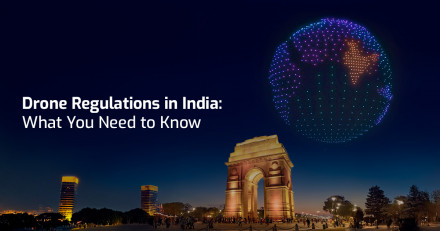 Indian drone technology has contributed significantly to the country's technological growth. The use of indigenous drones has become prevalent today. The use cases include event photography, surveillance, drone light shows, and agriculture purposes, etc. With the increase in the use of drones, it is important for drone professionals or hobbyists to be aware of the aviation rules. It's pivotal to ensure safety, privacy and national security.
The following article can be treated as a guide to Drone Regulations in India. This guide is heavily derived out of Drone Rules 2021. It has been designed to help both professionals and hobbyists to stay updated on the newest compliance requirements. It is mandatory for every drone professional or enthusiast to comply with the required regulations for flying drones legally in India.
Why Drone Regulations Are Important in India
Drone regulations have been set up in place to create a balance between innovation and drone safety in India. Without the mandatory compliance, the risks involved with drone operations increase significantly. The Government of India has started to take strict measures, enacting drone privacy laws to ensure safe drone operations in the country.
The Civil Aviation Authority of India has issued comprehensive safety guidelines that are to be followed for safe drone operations. There has been a spike in the commercial usage of drones in the past decade for activities such as architectural mapping, drone light displays, surveillance, etc. Certain measures have been put in place to ensure standardised operational practices for commercial purposes.
Drone regulations help avoid accidents and protect the privacy of people. A legal framework is compiled by authorities that allows the scaling of drone show operations while staying compliant with aviation regulations.
India's Drone Regulatory Authority
The Directorate General of Civil Aviation (DGCA), which comes under the Ministry of Civil Aviation (MoCA), has provided certain regulations which are to be followed for a safe flight in India's airspace.
The DGCA and the MoCA work hand-in-hand to ensure that the safety guidelines are being followed. The civil aviation authority, DGCA, frames policies for the operation of drones in India. This includes license approval, operations approval, and compliance to be followed.
It is mandatory to register the drone on the Digital Sky Platform as a part of the regulation process. Digital Sky can assist with pilot licensing procedures, flight approvals, and red-zone alerts. These guidelines improve transparency and safety during drone operations.

Key Drone Regulations in India
Drone Regulations 2021 guide professionals and hobbyists to fly a drone in India within the required safety standards.
Drone Categories in India (Weight Limits Explained)
DGCA has set up a few parameters for the classification of drones based on the maximum weight a drone could fly with.
- Nano Drones: Up to 250 grams
- Micro Drones: 250 grams to 2 kg
- Small Drones: 2 kg to 25 kg
- Medium Drones: 25 kg to 150 kg
- Large Drones: More than 150 kg
This classification of drones helps majorly with getting license approvals, operational permissions, and regulatory compliance. Drones with higher payload require stricter regulations as they may pose greater risks of compromising public safety.
Drone Registration
The drones can be registered on the Digital Sky Platform to get a Unique Identification Number (UIN). This UIN serves as a digital identity for the quadcopter.
To register a drone successfully over Digital Sky, one is required to submit the specifications of the drone, the owner's details, and a declaration of complying with the Drone Rules 2021, India. The cost of registering a drone on the Digital Sky Platform is nominal. The UIN of an aircraft will remain valid for the time the drone is operational and compliant with all the required regulations.
Remote Pilot License
Remote Pilot License (RPL) is issued by DGCA-authorised training centres, and is pivotal for drone pilots to operate UAVs in the country's airspace. Remote Pilot License signifies the expertise of drone pilots who possess vast knowledge of local aviation rules, safety guidelines, and fail-safe procedures.
A nano drone does not require a drone license to fly as long as they're being operated within safe flight zones, since they're mainly used for recreational purposes. However, drones which come under other classifications need a license for operations. Having a UAV pilot license goes to show professionalism and accountability across the country's growing modern drone industry.

No-Fly Zones & Geo-Fencing
To ensure safety during the flight, the country has set up no-fly zones throughout the country to mitigate risks associated with the use of drones. These restricted zones are set up around sensitive locations such as airports, military bases, international borders, monumental buildings, etc. for safety purposes.
Prior permissions are required for drones to be operated in a controlled airspace in urban areas. The Digital Sky Platform offers features such as geo-fencing alerting the pilot in real time if they enter a restricted into a area. It is critical for a UAV pilot to have a good understanding of the safety protocols set up by the aviation ministry to avoid violations.
Applying for Drone Flight Approvals
The Digital Sky Platform has made the process of applying for drone approvals a lot easier by digitizing the whole process. Firstly, users are required to create an account and register their drone to obtain a UIN. All the required documents including authentic identification, training certificates, and insurance policies are to be uploaded for gaining necessary permissions.
Once the pilot has registered the drone, the request for operational approvals can be raised by providing the area and time of the flight. If the intended area comes under a green zone, the platform will automatically grant permissions for the flight. However, for controlled airspaces, the request might take a few days for clearance.

Penalties upon Non-Compliance
It is mandatory for every drone operator, be it an individual or a business, to comply with the drone regulations set up by DGCA. Failing at compliance will result in ramifications such as financial penalties, confiscation of equipment, and appropriate legal action in accordance with the aviation laws of India.
Operating an unregistered drone, or flying it in a restricted airspace region can lead to serious violations. The Civil Aviation Authority of India has started to digitally monitor enforcing proper compliance. This makes it possible to adhere to the provided regulations to ensure safety and legal operation of drones in the region.
Key Takeaways from Drone Regulations
DGCA has formulated drone safety protocols in India to promote safe, legal and large-scale drone operations. It is crucial for a beginner to understand the factors such as drone classification, registration, license approval, safe zones, etc. for successful compliance. With the drone sector emerging at a vast scale in the country, it becomes the duty of a drone operator to stay updated on the latest guidelines provided for safe and legal operations. Practical industry implementations by organisations like Botlab Dynamics also help demonstrate how compliant and large-scale drone operations are executed in real-world scenarios.
FAQs
Q1. Do I need a license to fly a nano drone in India?
A1. No. You don't need a license to operate most of the nano drones in India as long as they're being flown in the safe-zones.
Q2. What happens if I accidentally enter a no-fly zone?
A2. The Geo-fencing feature will send you an alert as a warning to prevent the flight from taking place within the red zone.
Q3. Can foreign drone pilots fly in India?
A3. Yes. Foreign nationals are allowed to fly a drone in India as long as they have permission of the government
Q4. Is drone insurance compulsory in India?
A4. A drone insurance is not compulsory to have in India, but it is highly recommended for commercial operations of drones.
Q5. Is it allowed to fly drones at night in India?
A5. No, it's not permitted to fly drones at night unless the pilot/organiser has the required permissions from DGCA.

